

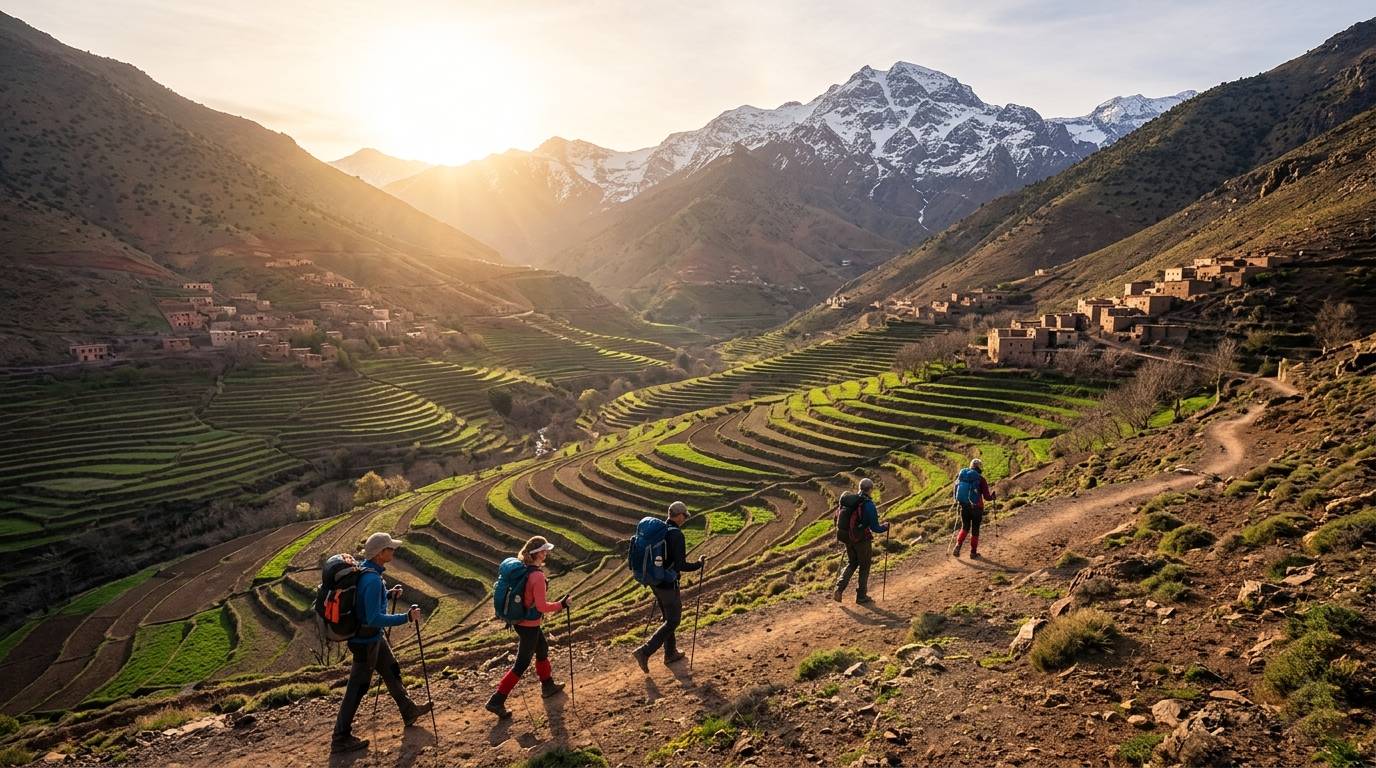
Morocco Hiking Guide | Best Trails 2026
A comprehensive Morocco hiking guide is essential for anyone planning trekking adventures across North Africa’s most spectacular mountain ranges and desert landscapes. Whether you’re a casual walker seeking gentle slopes or an experienced mountaineer chasing summit challenges, this guide covers everything you need to know about hiking in Morocco during 2026.
For two of the most popular specific routes covered here, see the dedicated Imlil Village base camp guide and the Toubkal summit trek guide, or the shorter Atlas Mountains day trip.
Morocco offers an incredible diversity of trekking experiences, from snow-capped peaks to verdant valleys and Saharan trails. The country’s varied terrain ensures that hiking enthusiasts of all abilities can find their perfect adventure.
Before embarking on any Moroccan trekking expedition, staying connected is crucial for safety and navigation. Consider checking our Best eSIM for Morocco in 2026: Tourist & Traveler Guide to ensure seamless communication while exploring remote mountain regions.
Complete Morocco Hiking Guide: Trails for Every Adventure Seeker
The Morocco hiking guide 2026 highlights over 30 exceptional trekking routes ranging from leisurely day hikes to multi-day mountain expeditions. Popular hiking destinations include the High Atlas Mountains, Anti-Atlas ranges, and the dramatic Rif Mountains in the north. Each region presents unique challenges, breathtaking vistas, and cultural encounters with Berber communities. Trail difficulty varies significantly, with elevation gains ranging from 300 meters on gentle walks to over 2,000 meters on technical climbs. Most trails require basic to intermediate fitness levels, though some demand serious mountaineering experience.
When planning your hiking adventure, understanding trail classifications helps match routes to your abilities. Moroccan hiking and trekking options span across multiple seasons, with spring and autumn offering ideal weather conditions. The best hiking guide resources include detailed topographic maps, elevation profiles, and estimated completion times. Prices for guided treks range from 400–800 MAD (€38–76) per day for group tours, while private guides cost 800–1,500 MAD (€76–143) daily. Budget-conscious hikers can tackle many routes independently using well-marked trails and detailed hiking maps.
- Over 30 distinct trekking routes across Morocco’s mountain ranges
- Elevation gains varying from 300 to 2,500+ meters depending on trail selection
- Guided trek prices: 400–800 MAD (€38–76) per day for groups
- Private guide costs: 800–1,500 MAD (€76–143) daily
- Best hiking seasons: April–May and September–October
Atlas Mountains: Beginner-Friendly Trails and Scenic Routes
The Atlas Mountains form Morocco’s backbone, stretching over 2,400 kilometers across the country. For your Morocco hiking guide to beginner trails, the Atlas region offers excellent introductory experiences. The Ourika Valley trek near Marrakech presents a stunning 12-kilometer round trip with minimal elevation gain (approximately 400 meters), ideal for families and casual walkers. This trail passes traditional Berber villages, refreshing waterfalls, and traverses lush cedar forests. Another excellent beginner option is the Imlil Valley walk, a gentle 8-kilometer route showcasing terraced farmland and snow-capped peaks in the distance.
The Kasbah Ait Benhaddou approach offers cultural enrichment combined with easy hiking, covering roughly 6 kilometers with minimal technical difficulty. Beginners particularly enjoy the Toubkal National Park’s lower elevation routes, which provide stunning views without requiring technical climbing skills. These accessible trekking paths typically take 4–6 hours to complete and cost 350–500 MAD (€33–48) per person with experienced local guides. Mountain refuge accommodations range from 80–150 MAD (€8–14) per night, making multi-day expeditions budget-friendly.
- Ourika Valley Trek: 12km round trip, 400m elevation gain, family-friendly
- Imlil Valley Walk: 8km through terraced farmland with minimal difficulty
- Kasbah Ait Benhaddou approach: 6km cultural and hiking combination
- Guide costs: 350–500 MAD (€33–48) per person daily
- Mountain refuge stays: 80–150 MAD (€8–14) per night
Intermediate Hiking Paths: Toubkal and Beyond
Mount Toubkal stands as North Africa’s highest peak at 4,167 meters, and the classic Toubkal trek represents the quintessential intermediate-level Moroccan hiking experience. The standard two-day route from Imlil to the summit covers approximately 20 kilometers with elevation gains exceeding 1,600 meters. Day one involves hiking 12 kilometers to Refuge Toubkal (3,207m), while day two covers the final 8 kilometers to the summit. Most hikers complete the ascent in 5–7 hours, enjoying panoramic views encompassing multiple mountain ranges. Two-day Toubkal guided packages cost 900–1,400 MAD (€86–133) including accommodation and meals.
Beyond Toubkal, intermediate hikers enjoy the M’Goun Trek, a spectacular four-day circuit through the High Atlas reaching 4,068 meters. This lesser-known route features dramatic red-rock formations, Berber settlements, and stellar camping locations. The M’Goun trek costs 1,400–2,000 MAD (€133–190) for four days including guide services and accommodation. For more flexible connectivity while trekking, explore our Morocco SIM Cards in 2026: eSIM vs Physical SIM – Tourist & Resident Guide for detailed comparison options. The Bou Iblan trek presents another intermediate challenge, covering 30 kilometers across five days with mixed terrain including rocky peaks and pastoral valleys.
- Mount Toubkal two-day trek: 20km, 1,600m elevation gain, 900–1,400 MAD (€86–133)
- M’Goun Trek four-day circuit: 4,068m peak, 1,400–2,000 MAD (€133–190)
- Bou Iblan Trek: Five-day 30km route with varied terrain
- Average hiking pace: 3–4 kilometers per hour on mountain trails
- Accommodation options: Mountain refuges or camping (80–200 MAD/€8–19 nightly)
Top-Rated Tours & Experiences
Advanced Trails: Challenging Routes for Experienced Hikers
Experienced mountaineers seeking challenging terrain should explore Morocco’s advanced hiking opportunities. The High Atlas Traverse represents one of North Africa’s most demanding multi-day expeditions, covering 80+ kilometers across technical terrain with altitude camps exceeding 3,500 meters. This expedition-style trek requires mountaineering experience, proper acclimatization protocols, and comprehensive fitness preparation. Guided High Atlas Traverse expeditions cost 3,500–5,000 MAD (€333–476) for eight to ten days including all logistics.
The Toubkal to M’Goun traverse combines two major peaks in a challenging seven-day expedition, covering approximately 50 kilometers with significant rock scrambling and altitude demands. Rock climbing experience proves valuable on certain sections. The Sirwa Trek in the Anti-Atlas mountains presents an alternative advanced option, featuring volcanic terrain, dramatic gorges, and authentic desert experiences across five days. Guided expeditions cost 1,800–2,500 MAD (€171–238) daily. For digital nomads planning extended hiking expeditions, our E-SIM for Digital Nomads in Morocco 2026: Stay Connected Anywhere ensures reliable communication throughout remote trekking areas. Winter mountaineering on snow-covered peaks demands specialized technical skills and appropriate equipment.
- High Atlas Traverse: 80+ kilometers, expedition-level challenge, 3,500–5,000 MAD (€333–476)
- Toubkal to M’Goun Traverse: 50km seven-day expedition with rock scrambling
- Sirwa Trek: Anti-Atlas volcanic terrain, 1,800–2,500 MAD (€171–238) daily
- Required experience: Mountaineering background and high-altitude acclimatization
- Equipment essentials: Technical climbing gear, ice axes, crampons for winter ascents
Essential Tips and Best Time to Hike in Morocco
Successful hiking in Morocco requires proper planning and preparation. The best Morocco hiking guide emphasizes seasonal timing, as spring (April–May) and autumn (September–October) offer optimal weather conditions with moderate temperatures and minimal precipitation. Summer months bring extreme heat to lower elevations, while winter creates snow challenges above 3,000 meters. Hydration remains critical—carry at least 2–3 liters of water per hiker, plus electrolyte tablets for longer expeditions. Mountain weather changes rapidly; always pack waterproof jackets, sun protection (SPF 50+), and quality hiking boots with proper ankle support.
Acclimatization is essential when hiking above 3,000 meters to prevent altitude sickness. Spend extra days at intermediate elevations before summit attempts. Hiring experienced local guides (400–800 MAD/
Related Articles
- Imlil Village Hiking | Toubkal Base Guide
- Toubkal Trek | North Africa’s Highest Peak
- Atlas Mountains Day Trip | From Marrakech
- Best SIM Card for Morocco 2026
Every city, the Sahara, transport, costs, safety, and a full Darija phrasebook — free, straight to your inbox.
Find the Best Morocco Tours
Compare 500+ tours, day trips and experiences — free cancellation and instant confirmation.
Frequently Asked Questions
What is the best Morocco hiking guide for beginners?
When is the best time to use a Morocco hiking guide?
Do I need a guide for hiking in Morocco?
What should I pack according to a Morocco hiking guide?
How difficult is Mount Toubkal according to hiking guides?
Every city, the Sahara, transport, costs, safety, and a full Darija phrasebook — free, straight to your inbox.
Get the free guide →🌍 Wanna hear more from Morocco?
Weekly travel tips, hidden gems and new guides — straight to your inbox.
Free, no spam, unsubscribe anytime.