

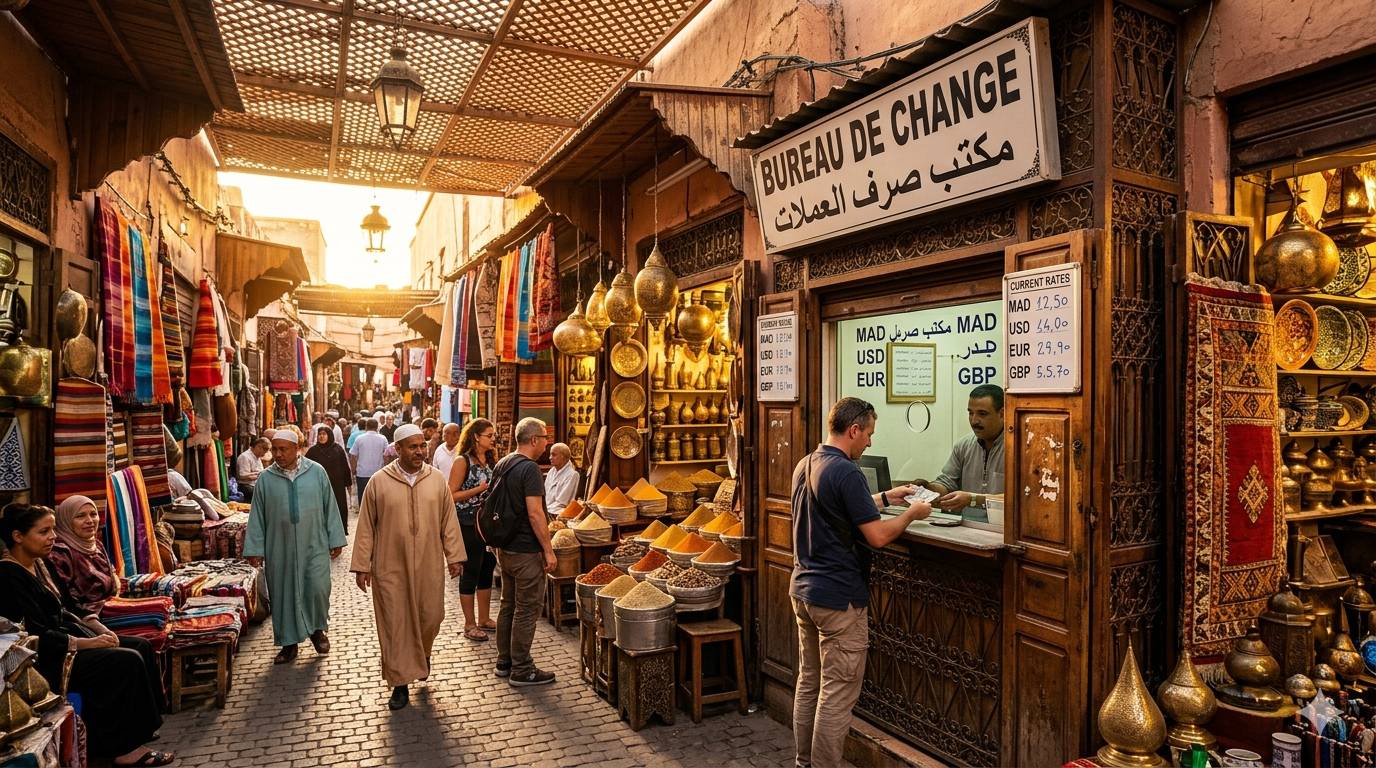
Morocco Currency: MAD Exchange Rate Tips
Your Morocco currency guide MAD exchange is essential before traveling to this North African gem. The Moroccan Dirham (MAD) is the official currency, and understanding how to exchange money effectively can save you hundreds of dollars during your stay.
In 2026, exchange rates fluctuate based on international markets, but knowing the current MAD to EUR and USD conversions helps you budget accurately. Whether you’re booking Best Airbnb Rentals in Morocco: Top Locations, Prices & Tips for Tourists (2026) or planning your desert adventures, having the right financial knowledge is crucial.
This comprehensive Morocco currency exchange guide covers everything from ATM withdrawals to avoiding unfavorable rates, ensuring you maximize your spending power throughout your Moroccan adventure.
Morocco Currency Guide MAD Exchange: What You Need to Know in 2026
The Moroccan dirham exchange rate in 2026 remains relatively stable against major currencies. As of early 2026, 1 EUR equals approximately 11.20-11.50 MAD, while 1 USD converts to around 10.00-10.30 MAD. These figures fluctuate daily based on market conditions, so checking current rates before departure is essential for accurate budgeting. The MAD is not freely traded internationally, meaning you cannot exchange it before leaving your home country—you must exchange currency upon arrival or withdraw directly from ATMs.
Understanding the Moroccan currency system helps you navigate transactions smoothly. The dirham divides into 100 fils, though fils coins are rarely used in modern transactions. Banknotes come in denominations of 20, 50, 100, and 200 MAD, while coins are minted in 1, 5, and 10 MAD. Most daily transactions in Morocco use cash, though card payments are increasingly accepted in major cities. When planning activities like attending Best Festivals in Morocco 2026 (Full Calendar + Dates, Tips & Highlights), carrying sufficient MAD cash ensures smooth transactions at local vendors and small businesses.
- Current exchange rates: 1 EUR ≈ 11.20-11.50 MAD; 1 USD ≈ 10.00-10.30 MAD
- MAD cannot be exchanged before traveling to Morocco
- Cash remains the primary payment method in smaller towns and markets
- Major credit cards are accepted in hotels, restaurants, and shopping centers
- Inform your bank before traveling to avoid transaction blocks
Understanding the Moroccan Dirham (MAD) and Current Exchange Rates
The Moroccan dirham exchange value depends on several factors including economic conditions, tourism demand, and global currency markets. In 2026, the MAD has maintained relative stability compared to volatile currencies in emerging markets. When converting larger amounts, the differences between exchange rates can be significant—for example, exchanging €1,000 at a 11.20 rate yields 11,200 MAD, while a 11.50 rate gives you 11,500 MAD. That’s a 300 MAD difference (approximately €27), making smart exchange decisions worthwhile.
Tourist hotspots and international airports typically offer less favorable MAD exchange rates than local banks or ATMs. Airport exchanges in Marrakech, Casablanca, and Fez charge commissions ranging from 3-5%, while bank rates are generally more competitive. If you’re planning winter activities, check our guide on Best Places to Visit During Snowfall in Morocco: Winter Guide & Tips (2026) to understand how seasonal factors affect tourism and exchange rates. The dirham’s stability makes it easier to predict daily expenses—a meal in a local restaurant costs 50-80 MAD (€4.50-7), while mid-range hotels average 300-500 MAD per night (€27-45).
- Airport exchanges: 11.00-11.10 MAD per EUR (includes 3-5% commission)
- Bank exchanges: 11.20-11.40 MAD per EUR (best rates, minimal fees)
- Tourist shops: 10.80-11.00 MAD per EUR (worst rates, avoid if possible)
- Real-time rates update daily; use XE.com or OANDA for current conversions
- Peak tourism seasons (April-May, September-October) see slightly higher rates
Best Practices for Exchanging Money in Morocco
Exchanging money wisely requires planning and knowledge of available options. Your best approach involves combining multiple methods: withdraw cash from ATMs for the best rates, use credit cards for major purchases, and carry a backup card for emergencies. Never exchange at airport kiosks as your first option—those currency exchange rates include hefty markups of 4-5%. Instead, withdraw 500-1,000 MAD from an ATM upon arrival, then exchange additional currency at banks throughout your journey.
Bank branches in every major city offer competitive Moroccan dirham rates with minimal fees. Banque Marocaine du Commerce Extérieur (BMCE) and Attijariwafa bank have extensive networks across Morocco and offer favorable rates for cash exchanges. Bring your passport, as banks require identification for currency transactions. When traveling through remote areas or planning connectivity needs, remember that checking Does eSIM Work in the Sahara Desert Morocco 2026? Coverage & Tips helps you research exchange options before traveling to isolated regions. Money changers (bureaux de change) operating independently charge 2-3% commission and should be used only if banks are unavailable.
- ATM withdrawals: Best rates, typically 11.15-11.35 MAD per EUR
- Bank exchanges: Competitive rates, modest 1-2% fees, require passport
- Money changers: 2-3% commission, convenient but costlier than banks
- Exchange at least €100-150 to cover immediate expenses before finding ATMs
- Avoid exchanging small amounts; combine with other travelers to reduce fees
Top-Rated Tours & Experiences
ATM Guide: Finding and Using Cash Machines in Morocco
Automated teller machines provide the most reliable method for obtaining Moroccan currency at favorable exchange rates in Morocco. ATMs are abundantly available in Casablanca, Marrakech, Fes, Tangier, and other major cities, typically charging 1-2% fees compared to banks’ 2-3% rates. Maroc Telecom, Banque Populaire, and BMCE ATMs are most traveler-friendly, accepting Visa, Mastercard, and most international debit cards. Withdrawal limits vary by bank and card type, typically ranging from 2,000-5,000 MAD per transaction (€180-450).
Strategic ATM usage maximizes your funds and minimizes fees. Withdraw 3,000-5,000 MAD in single transactions rather than multiple small withdrawals, as each transaction incurs fees. ATMs in airports and city centers are reliable, but smaller towns may have limited machines. Keep your PIN secure and use ATMs during daylight hours in populated areas for safety. Your bank may charge additional international transaction fees (typically €2-3), so anticipate total costs when calculating expenses. For longer stays, planning visits to multiple ATMs during city exploration ensures steady cash availability without carrying excessive amounts.
- Major ATM networks: BMCE, Banque Populaire, Maroc Telecom, Crédit Agricole
- Typical withdrawal fees: 1-2% charged by Moroccan banks, plus your home bank fees
- Daily withdrawal limits: 2,000-5,000 MAD (€180-450) per transaction
- Safest locations: Airport ATMs, hotel lobbies, shopping centers, city centers
- Have a backup card; always carry two payment methods for emergencies
Money-Saving Tips for Currency Exchange and Banking in Morocco
Maximizing your budget requires strategic decisions about currency exchange and banking in Morocco. First, understand that your home bank’s exchange rates include markups of 3-5%, making ATM withdrawals in-country far superior. Never use airport currency exchanges as your primary source—their rates are 1-2% worse than banks. Calculate your daily budget using current rates: a moderate daily budget of €30-50 covers meals, transportation, and modest accommodations in non-tourist areas, while €60-100 daily suits comfortable mid-range travel.
Credit cards provide backup payment methods for hotels and restaurants but carry 2-3% foreign transaction fees from most banks. Some premium travel cards offer fee waivers—contact your bank before departure. Tipping (bakshish) expectations in Morocco differ from Western standards; rounding up restaurant bills or adding 10-15% MAD for exceptional service is appreciated but not mandatory. By combining ATM withdrawals, strategic bank exchanges, and selective card usage, you’ll optimize your Morocco currency guide experience and stretch your travel budget effectively. Whether exploring coastal cities or desert landscapes, financial preparedness ensures you
Related Articles
- Best Airbnb Rentals in Morocco: Top Locations, Prices & Tips for Tourists (2026)
- Does eSIM Work in the Sahara Desert Morocco 2026? Coverage & Tips
- Does eSIM Work in the Sahara Desert Morocco 2026? Coverage & Tips
- Best Festivals in Morocco 2026 (Full Calendar + Dates, Tips & Highlights)
- Best Places to Visit During Snowfall in Morocco: Winter Guide & Tips (2026)
Every city, the Sahara, transport, costs, safety, and a full Darija phrasebook — free, straight to your inbox.
Find the Best Guided Tours & Experiences
Compare 500+ Morocco tours — desert camps, city tours, food walks & day trips. Free cancellation on most.
Frequently Asked Questions
What is the current exchange rate for the Moroccan Dirham (MAD) in 2026?
Is it better to exchange money before traveling or in Morocco?
Are ATMs widely available throughout Morocco?
What fees should I expect when withdrawing cash from ATMs in Morocco?
Is it safe to carry large amounts of cash in Morocco?
Every city, the Sahara, transport, costs, safety, and a full Darija phrasebook — free, straight to your inbox.
Get the free guide →🌍 Wanna hear more from Morocco?
Weekly travel tips, hidden gems and new guides — straight to your inbox.
Free, no spam, unsubscribe anytime.